
BIOBOX, with technology developed by INGEOBRAS, is promoting biological denitrification as an efficient alternative to reverse osmosis for removing nitrates from water with lower operating costs and greater sustainability.
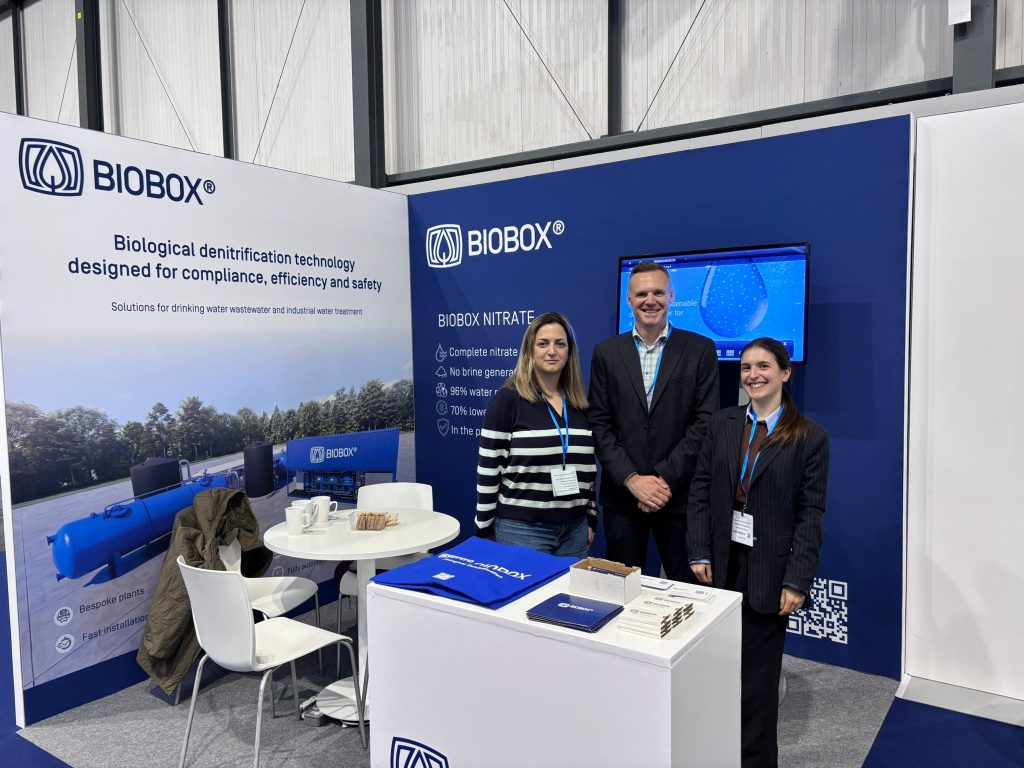
BIOBOX will present its biological denitrification solution at Utility Week Live, held in Birmingham on 19 and 20 May, as part of its strategy to address this growing water quality challenge on an international scale. The presence of nitrates in water has become one of the main environmental and public health challenges in Europe, with countries such as the United Kingdom, Germany, the Netherlands, France, Denmark and Spain recording high concentrations, especially in areas with intensive agricultural activity.
The growing problem of nitrates in water
The main source of nitrate pollution is the intensive use of fertilisers. It is estimated that between 50% and 60% of nitrates reaching aquatic environments come from agriculture, exceeding 70% in some regions.
The problem is also cumulative. Nitrates slowly infiltrate into the ground and can take decades to reach aquifers. This delayed effect makes control more difficult and prolongs the impact over time.
From an environmental perspective, nitrate pollution contributes to eutrophication processes that damage aquatic ecosystems. From an operational perspective, it increases water treatment costs, as utilities, municipalities and industries must comply with increasingly demanding regulations.
Spain and the United Kingdom: two examples of a structural problem
The United Kingdom is a particularly representative case. In the south and east of England, nitrate concentrations in groundwater have progressively increased due to decades of agricultural pressure.
Spain is also affected by this situation. Despite regulatory progress, there are still many nitrate vulnerable zones where nitrate levels in drinking water exceed recommended limits.
This highlights the urgent need for effective, sustainable and scalable nitrate removal solutions capable of addressing the problem at its source.
Reverse osmosis: an effective technology with limitations
For years, the predominant technology for nitrate removal has been reverse osmosis.
Although reverse osmosis is effective from a separation perspective, it presents significant limitations:
- High energy consumption
- Generation of highly concentrated reject streams
- Need for additional waste management
- Lower water efficiency due to treated water losses
In many cases, this approach does not eliminate the problem. It simply transfers it elsewhere, creating new environmental and operational challenges.
Biological denitrification: a paradigm shift in water treatment
Compared with this model, biological denitrification offers a completely different approach.
It is a natural process in which specific bacteria transform nitrates, NO₃⁻, into nitrogen gas, N₂, which is released into the atmosphere without environmental impact.
Unlike separation technologies, biological denitrification:
- Eliminates the contaminant instead of concentrating it
- Does not generate reject streams
- Reduces the overall environmental impact
- Improves water treatment efficiency
This change in approach is essential. The objective is not only to comply with regulations, but to do so in a sustainable, efficient and responsible way.
Proprietary technology for nitrate removal
BIOBOX, with technology developed by INGEOBRAS, has taken biological denitrification to a new level through solutions such as Puremust SN.
This system enables the biological process to be applied in controlled environments, ensuring:
- High nitrate removal efficiency
- Operational stability
- Precise process control
- Adaptability to different flow rates
In addition, Puremust SN is available in compact, modular and containerised formats, making it easier to implement in multiple contexts:
- Small municipalities
- Industrial facilities
- Decentralised water treatment systems
- Water reuse projects
Advantages over reverse osmosis
The biological denitrification technology applied by BIOBOX offers clear advantages over conventional nitrate removal technologies.
1. Lower operating costs
Thanks to lower energy consumption and the absence of reject streams, operating costs are significantly reduced.
2. High water efficiency
The system enables very high water recovery, avoiding unnecessary water losses in a context of increasing water scarcity.
3. Real sustainability
By avoiding the generation of concentrated waste streams, the problem is eliminated at its source, reducing environmental impact.
4. Flexibility and scalability
Modular systems can adapt to different needs, from small installations to large-scale treatment plants.
Puremust SN: optimising a natural process
The key to Puremust SN technology lies in the optimisation of a natural process within a fully controlled environment. This approach makes it possible to continuously maintain the optimum conditions for the development of denitrifying bacteria, resulting in stable and predictable operation.
As a result, consistent nitrate removal performance can be achieved while minimising potential deviations in treated water quality. In addition, the integration of advanced automation and control systems allows the process to be adjusted in real time, optimising performance and reducing operational intervention.
The result is a robust and reliable solution, designed to meet not only current standards but also future water treatment requirements.
The international expansion of biological denitrification
BIOBOX will present this technology at Utility Week Live in Birmingham, on 19–20 May, as a strategic step in its international expansion.
The United Kingdom is positioned as a priority market due to:
- The scale of the nitrate problem
- Increasing regulatory pressure
- The need for sustainable water treatment solutions
However, the challenge is global. Nitrate pollution affects much of Europe, and its evolution points to growing demand for technologies that provide structural, long-term solutions.
The future of water treatment means doing it better
In a scenario where treatment costs continue to rise and pressure on water resources is increasing, efficiency is no longer optional. It has become a necessity.
The future of water treatment requires a change in approach based on process optimisation: reducing energy consumption, maximising water recovery and removing contaminants without generating residual streams that simply transfer the problem elsewhere. All of this must be integrated into sustainable and scalable solutions capable of adapting to different contexts and demands.
In this sense, biological denitrification is positioned as an alternative aligned with this new paradigm, offering a more efficient and responsible way to address nitrate removal.
From treating water to optimising water treatment
Nitrate removal can no longer be approached solely from the perspective of regulatory compliance.
A broader approach is needed, integrating efficiency, sustainability and operational feasibility.
BIOBOX, supported by INGEOBRAS technology, is positioning biological denitrification as a real alternative to reverse osmosis, capable of responding to today’s water treatment challenges.
Because today, more than ever, it is not only about treating water. It is about treating it better.